





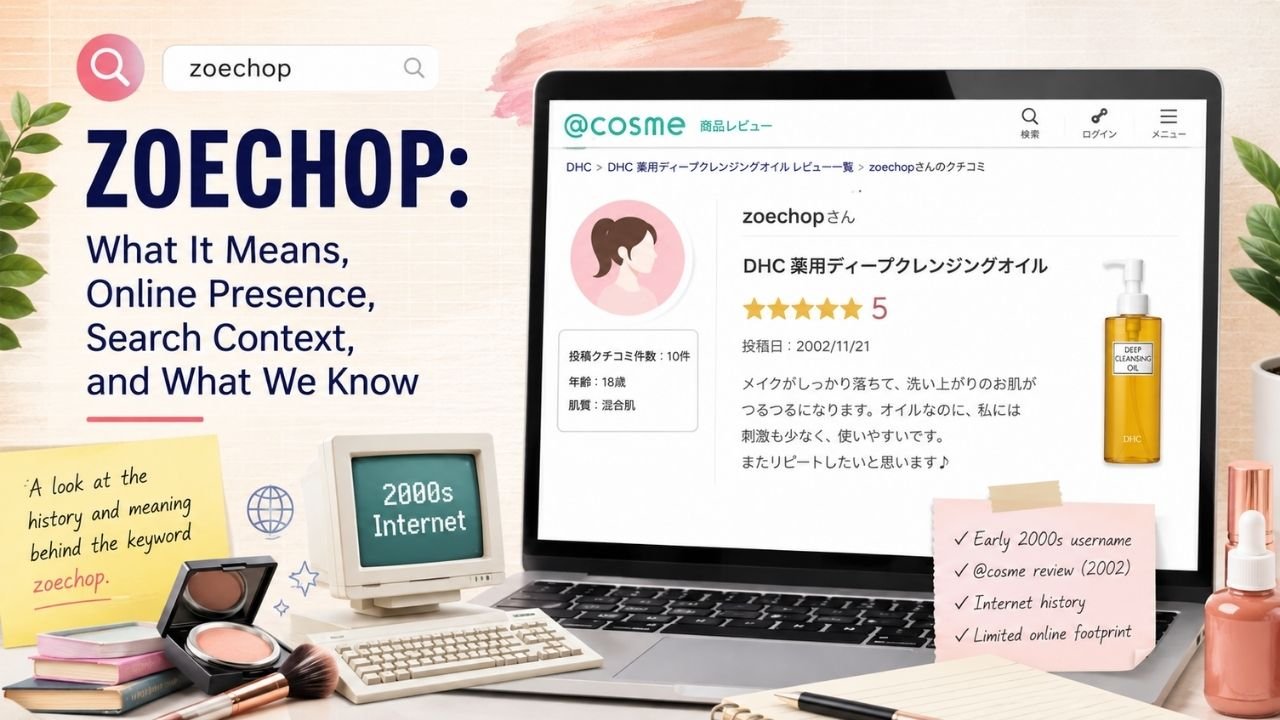
The zoechop is an unusual search term that does not currently appear to be associated with a major company, established brand, popular website, or widely recognized online service. Because the term is relatively uncommon, people searching for zoechop may be looking for a specific username, an old online profile, a piece of internet history, or information connected with a particular individual or platform.
Available indexed information provides an important clue about the term. A search result on the Japanese beauty and cosmetics platform @cosme shows a reviewer named zoechop in connection with a product review published in 2002. The profile appears alongside a review of DHC’s Deep Cleansing Oil, giving us one of the clearest publicly indexed contexts in which the keyword appears.
However, it is important not to confuse a historical username with a modern company, website, or brand without supporting evidence. This article explores zoechop, its available online context, what can reasonably be established about it, and why searches for uncommon terms like this can sometimes yield limited information.
What Is Zoechop?
Zoechop is a distinctive online term used as a username or profile name. Unlike keywords associated with well-known companies or platforms, there is insufficient reliable evidence to establish zoechop as the name of a major commercial service or technology platform.
One of the most notable indexed references comes from @cosme, a Japanese cosmetics and beauty information website. The site contains a historical product review attributed to a user named zoechop. According to the indexed page, the review was published on November 21, 2002.
This makes the term particularly interesting from an internet-history perspective. Usernames created in the early 2000s can remain indexed by search engines for decades, even after the original user is no longer active on the platform.
Therefore, when someone searches for zoechop, the search results may point to this historical profile rather than a currently operating website.
Zoechop and @cosme
The strongest publicly indexed connection for zoechop is the Japanese beauty platform @cosme.
The relevant page is a product review for DHC Medicated Deep Cleansing Oil. The review is attributed to “zoechopさん,” indicating that zoechop was the username associated with the contribution. The page records that the reviewer had posted 10 reviews on the platform at that point.
The review received a rating of 5 and was posted in 2002. It describes the user’s experience with the cleansing product, particularly its ability to remove makeup and its perceived effect on skin texture.
This historical reference is significant because it demonstrates that the keyword zoechop has existed online for many years.
At the same time, the existence of this profile does not prove that every current search for “zoechop” relates to the same person. A username can be reused, modified, or independently created by different people across different websites.
The Historical Significance of the Zoechop Keyword
One reason zoechop is interesting is its connection to an online review from the early 2000s.
Today, social media users regularly create profiles on dozens of platforms, and usernames can quickly become associated with a person’s digital identity. In the early 2000s, however, online communities often revolved around forums, review sites, blogs, chat services, and specialist communities.
The @cosme reference shows how usernames from that period can persist in search indexes long after the original activity occurred.
The historical review associated with zoechop therefore provides a small example of how early user-generated content became part of the searchable internet.
Rather than treating zoechop as a modern brand automatically, it is more accurate to describe the keyword as an uncommon online identifier with at least one documented historical use.
What Does the Zoechop Profile Tell Us?
The available @cosme page provides several pieces of information about the historical account. The profile is associated with a user named zoechop, and the review page states that the reviewer had submitted 10 reviews. The page also lists the reviewer as 18 years old and identifies the skin type as combination skin at the time of the review.
The review itself gives an opinion about the DHC cleansing oil. The reviewer said that the product removed makeup effectively and left the skin feeling smooth. The review also described the product as relatively gentle for the reviewer and stated an intention to use it again.
These details should be understood strictly as information presented on the historical review page. They should not be interpreted as evidence of the person’s current age, lifestyle, location, or activities.
This distinction is particularly important when researching old usernames.
Is Zoechop a Website?
There is currently insufficient reliable evidence to describe zoechop as a standalone website.
Searchers sometimes encounter uncommon keywords and assume that the term must represent a domain, application, online store, or digital service. However, a keyword can also be:
- A username
- A nickname
- A profile name
- An old forum identity
- A search typo
- A personal brand
- A short-lived website name
- A combination of words created for an online account
In the available evidence, the clearest use of zoechop is as a username on a historical @cosme review.
Without additional authoritative sources, claiming that zoechop is a particular modern website or business would be speculative.
Why People May Search for Zoechop
There can be several reasons to search for an uncommon keyword such as zoechop.
First, someone may have encountered the name on an old webpage and want to understand who or what it represents.
Second, searchers may be researching historical usernames or online profiles.
Third, the keyword could have appeared on another website, in a social media post, an article, or an archived page that is not currently well indexed.
Another possibility is that users are searching for a domain or platform they believe is associated with the term.
Because the keyword has limited documented results, search intent is difficult to determine with certainty. The best approach is therefore to use verified search evidence rather than assume a specific meaning.
Zoechop and Online Usernames
The story behind zoechop illustrates how usernames can become searchable digital artifacts.
An online username may have little significance when first created. A person might choose a combination of letters because it sounds memorable, reflects a nickname, or is simply available. Once used on a public platform, however, that username can become permanently associated with published content.
Search engines may continue to index old pages, allowing usernames to appear decades later.
This creates an interesting relationship between usernames and internet history. A keyword that looks meaningless to a modern searcher can sometimes lead to a very specific historical webpage.
The zoechop reference on @cosme is an example of this phenomenon.
What Was the Zoechop Review About?
The indexed review associated with zoechop concerns DHC’s Deep Cleansing Oil.
The reviewer gave the product a score of 5 and discussed several personal impressions. According to the translated Japanese review, the product was appreciated for its makeup-removing ability and the smooth feeling after use. The reviewer also stated that although oil cleansers were not generally preferred, this particular product was comfortable enough to encourage repeat use.
The review was posted on November 21, 2002, making it a historical piece of user-generated beauty content.
Importantly, this should be regarded as an individual product opinion rather than a universal assessment.
Why Historical Search Results Can Be Misleading
When researching an unusual keyword such as zoechop, search engines can return pages that are many years old.
This can create several problems.
A searcher might assume that an old profile is still active. Another person might assume that a username belongs to the same individual across different platforms. A historical age shown on an old profile might also be mistaken for the person’s current age.
These assumptions are not justified without additional evidence.
For this reason, researchers should pay attention to publication dates, platform names, page context, and the exact wording used by the source.
In the case of zoechop, the available evidence points clearly to an old @cosme review, but it does not establish a current public identity or business associated with the keyword.
Is Zoechop Still Active?
There is not enough reliable public information to confirm whether the original zoechop account remains active today.
The available result is a historical review page dated 2002. A search result remaining accessible does not necessarily mean that the account holder is currently using the platform.
Old content can remain online for many years because websites preserve user reviews and historical databases.
Therefore, it is more accurate to say that zoechop has a documented online presence, rather than to claim the account is currently active.
How to Research an Uncommon Keyword Like Zoechop
Researching a rare keyword requires a slightly different strategy from researching a mainstream brand.
Start by searching the exact term in quotation marks. This helps identify pages containing the precise spelling.
Next, examine the oldest and most authoritative results. In the case of zoechop, the @cosme result provides a concrete historical reference.
Researchers should then compare different search results to determine whether they refer to the same entity.
It is also useful to distinguish between:
- Verified information
- User-generated content
- Search-engine snippets
- Unconfirmed claims
- Current information
- Historical information
This method reduces the risk of turning a small piece of evidence into an unsupported story.
What We Can Confirm About Zoechop
Based on the currently available indexed evidence, several facts can reasonably be stated.
Zoechop appears as a username: The clearest documented use is an @cosme profile/reviewer name.
There is a historical beauty review: The username is attached to a DHC Deep Cleansing Oil review.
The review dates to 2002: The page records November 21, 2002, as the publication date.
The account had multiple reviews: The page states that the reviewer had posted 10 reviews.
There is no strong evidence that zoechop is a major modern brand: The available evidence does not establish the keyword as a widely recognized company, platform, or service.
These distinctions make the available information more useful and trustworthy.
What We Should Not Assume About Zoechop
Several claims should not be made without additional evidence.
It would be inappropriate to assume that the historical @cosme profile represents a currently active individual.
It would also be inappropriate to connect the username with unrelated social media accounts simply because the same or a similar name appears elsewhere.
Similarly, the historical age shown on the old profile should not be treated as a current age.
Finally, the existence of a username should not automatically be interpreted as evidence of a business or website.
A responsible article about zoechop should clearly separate documented facts from speculation.
Frequently Asked Questions About Zoechop
What is zoechop?
Zoechop is an uncommon online keyword that appears in at least one historical public context as a username on the Japanese beauty platform @cosme.
Is zoechop a website?
There is not enough reliable evidence to confirm that zoechop is a standalone website. The clearest indexed reference identifies it as a username associated with an @cosme review.
When did zoechop appear online?
A documented @cosme review under the username zoechop dates to November 21, 2002.
What product did zoechop review?
The documented review concerns DHC Deep Cleansing Oil. The reviewer gave it a rating of 5 and described positive experiences with makeup removal and skin feel.
Is zoechop a brand?
There is insufficient evidence to identify zoechop as an established commercial brand. The available evidence is primarily connected with a historical username.
Final Thoughts on Zoechop
Zoechop is an example of how seemingly obscure search terms can lead to interesting pieces of internet history. Rather than representing an obvious modern company or technology platform, the strongest available evidence connects the term with a historical @cosme username and a beauty-product review published in 2002.
Read Next: Troozer Com: A Complete Guide to the Website, Features, Uses, Safety, and What Users Should Know